When Coral Neighbors Touch: Observe the Boundary
A reef aquarium is a growing community. Two colonies that fit beside each other today may eventually occupy the same space, and similar colors or trade names do not guarantee compatibility.
Contact can change the picture
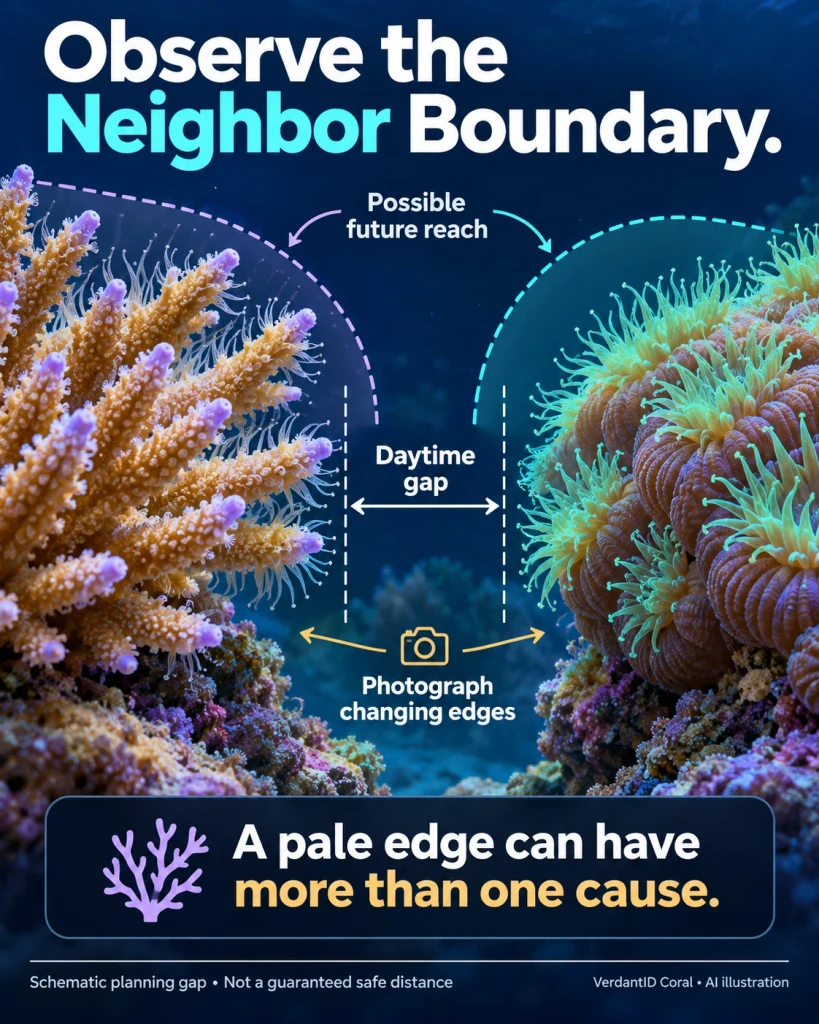
Tentacles, living tissue and other interactions can affect a neighboring colony. The pattern varies by animal and conditions; every pale edge is not automatically a sting. Growth, abrasion and other causes still belong in the investigation.
Check more than the daytime gap
Observe the boundary under the usual light cycle and, where practical, after lights-out. Photograph the whole arrangement as well as any affected edge. Avoid putting hands between colonies to test whether tentacles sting.
Plan for the next stage
- Leave room for growth rather than filling every gap.
- Keep supports stable and tissue clear of rough contact.
- Record when a neighboring colony was added or moved.
- Use species-aware spacing rather than one distance for all corals.
Respond to the evidence
If a boundary is changing, compare the timeline and other conditions before concluding that competition is the cause. Rapid tissue loss deserves prompt informed help. The diagram shows a planning gap, not a guaranteed safe distance or an actual injury.
Join the discussion
Which of your corals needs extra space?
Sources and further reading
Source: Original Verdant guide