Too Much Flow? Watch the Pattern Around the Coral
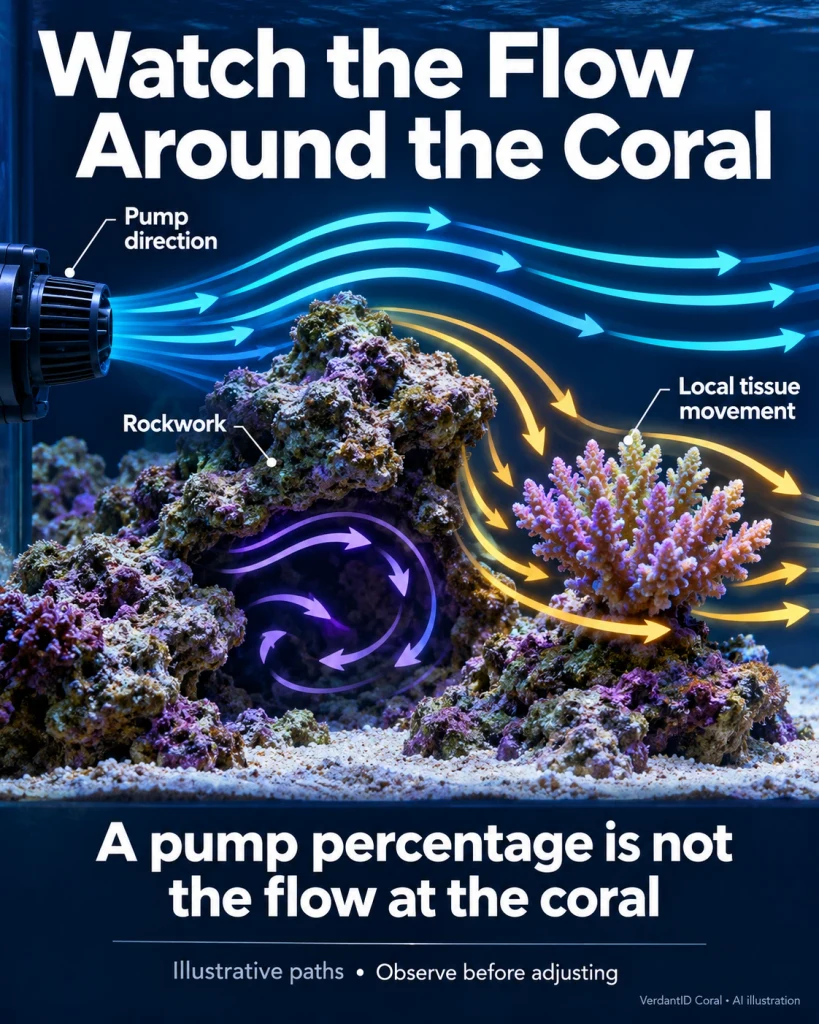
A powerhead percentage says little about the current that reaches a particular coral. Rockwork, pump direction and neighboring growth can create a very different local flow pattern.
Look beyond the pump setting
Observe the animal from more than one angle. Is tissue continuously pressed in one direction, barely moving, or moving through a changing current? These are useful descriptions, but they do not establish a single diagnosis or a universal ideal. Different coral forms respond differently.
Record the whole arrangement
Show where the pump sits relative to the colony and rock. A short steady video can provide more context than a close still photograph. Note the timing if a cleaning, new pump or changed program preceded the concern.
Before adjusting
- Check that the pump is functioning as intended.
- Consider light history, tissue condition and other recent changes too.
- Avoid moving the coral repeatedly while changing several pump settings.
- Leave enough room for growth to alter circulation over time.
Use the response as evidence
If making a justified adjustment, record what changed and observe. Do not interpret one moment of increased extension as proof that the original cause has been solved. No universal turnover figure or pump percentage is prescribed here.
Join the discussion
Where is your powerhead aimed?
Related Community reading
Sources and further reading
Source: Original Verdant guide