PAR Explained: What the Light Meter Actually Measures
PAR is useful reefkeeping language, but the acronym and the number on a meter are often used interchangeably. Knowing what is being measured makes comparison more meaningful.
A defined band of light
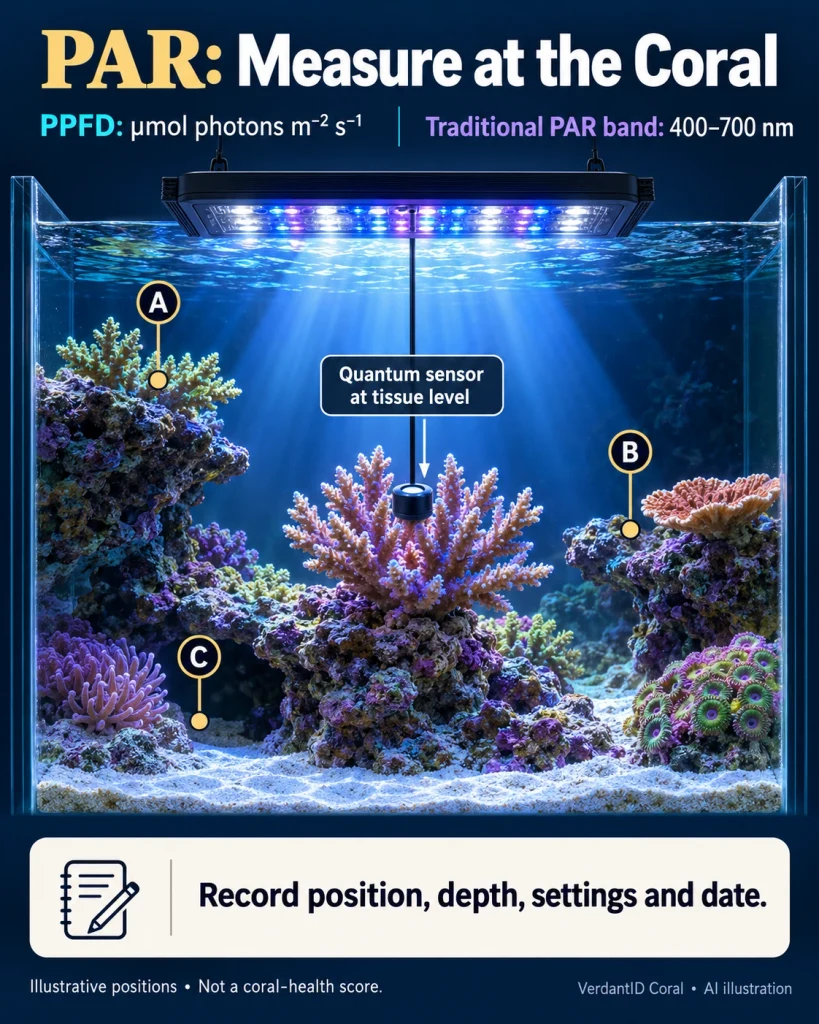
Photosynthetically active radiation traditionally describes light in the 400–700 nanometer band. Aquarium quantum meters commonly report photosynthetic photon flux density in micromoles of photons per square meter per second. That measurement is not a direct coral-health score.
The location matters
A reading changes with position, depth, shading and sensor orientation. Water movement and nearby surfaces can affect repeatability. Use the instrument's underwater and spectral guidance; a fixture percentage or phone brightness setting is not automatically equivalent to a calibrated meter reading.
Make a useful map
- Record the meter, light settings and measurement position.
- Measure where the coral tissue actually sits.
- Note rock shadows and changing colony growth.
- Keep the map alongside the date and acclimation history.
Keep the limits visible
A photon count in this band does not describe every wavelength or provide a universal requirement for all corals. Use animal-specific information and prior conditions to interpret the map, rather than choosing a single number for every shelf.
Join the discussion
Have you ever borrowed a PAR meter?
Sources and further reading
Source: Original Verdant guide