Place a New Torch Coral With Its Future Size in Mind
The first available gap in the rockwork may not be a useful long-term position. A placement plan should consider previous conditions, current exposure and room for the colony to change.
Ask about the previous home
Save the best-supported identification and ask the seller or grower about the coral's earlier light, flow and recent handling. A shop tank's appearance is not a measured light value, and matching a light fixture's percentage does not necessarily match exposure.
Plan space around the living tissue
Consider nearby colonies and potential tentacle reach, including after lights-out. Do not assume related trade names guarantee compatibility. Keep tissue clear of abrasion and unstable supports; avoid handling a coral by its fleshy parts.
Evaluate the candidate position
- Observe how the current reaches that location.
- Consider light exposure and an appropriate acclimation plan.
- Allow access for photographs and observation.
- Think about growth, maintenance and future neighboring colonies.
Avoid constant relocation
Record the chosen location and conditions. Repeated moves can obscure which change had an effect. Placement is one part of care, not a guarantee of extension or health; if the coral is declining, include measured readings and tissue observations when seeking help.
Join the discussion
How do you choose a new coral's spot?
Related Community reading
Sources and further reading
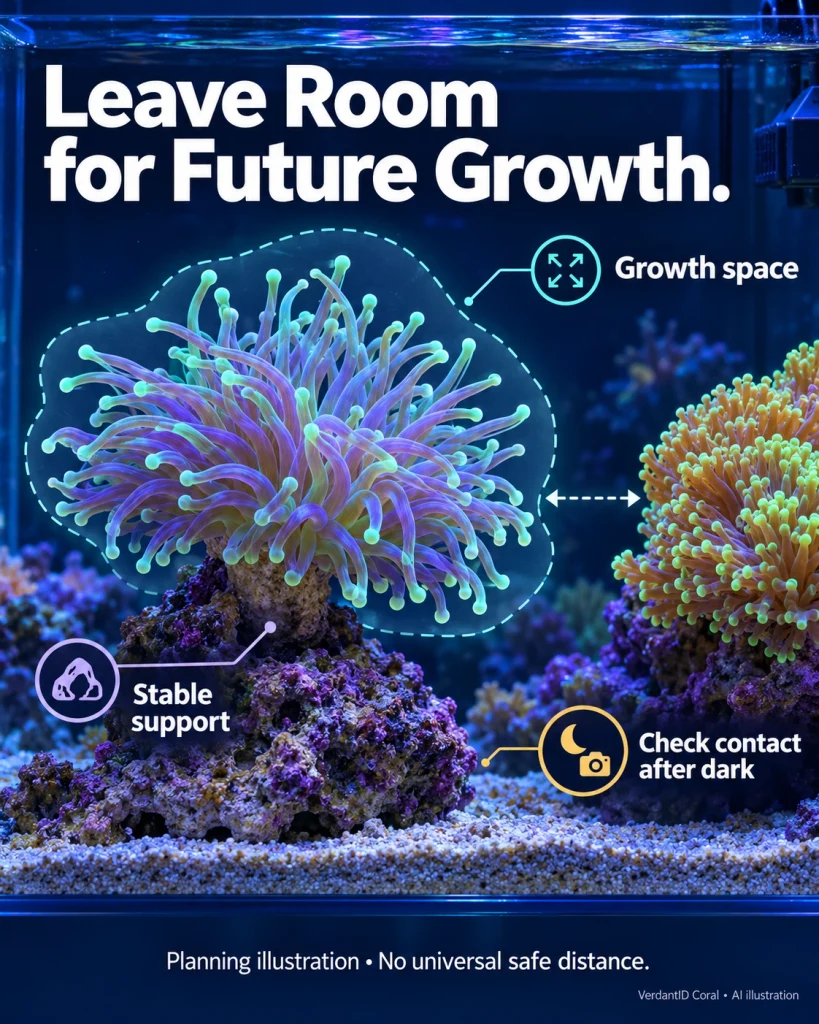
Source: Original Verdant guide