Why Blue Light Makes Coral Colors Look Different
A reef can look dramatically different when its lighting changes from a broad white appearance to strong blue illumination. That visual change combines biology, lighting and the camera.
Fluorescence needs incoming light
Fluorescent molecules absorb light and emit some of that energy at a longer wavelength. This is different from simply reflecting the light that falls on the coral. The glow seen under blue illumination is also different from an animal producing bioluminescent light.
The camera changes the story
Automatic white balance, exposure and color processing can exaggerate or suppress the effect. An orange filter can change the recorded appearance too. Two photographs with different settings are not a reliable before/after health comparison.
For a more honest comparison
- Keep an unedited original.
- Record the lighting mode and any lens filter.
- Repeat the distance, exposure and viewing angle.
- Add a neutral-looking view when asking about a color change.
Color is not a health score
Fluorescence has scientific uses, but a vivid phone photograph alone cannot establish coral health. Consider tissue, behavior, recent changes and measured conditions alongside the image.
Join the discussion
What is your most fluorescent coral?
Sources and further reading
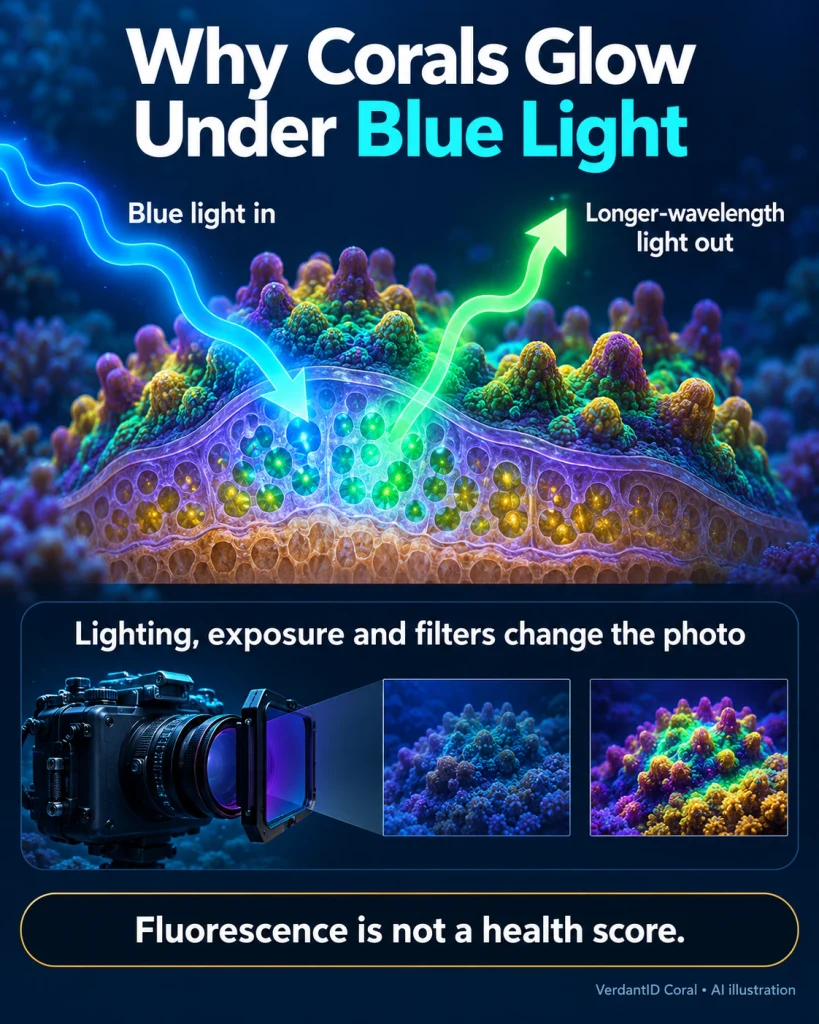
Source: Original Verdant guide