Nitrate and Phosphate: Why Zero Isn't Automatically Better
If a test reads zero, is the reef thriving? Not necessarily. Corals and their symbiotic organisms need nutrients. Research shows that nutrient limitation and nutrient imbalance can affect corals, but responses vary with species and experimental conditions; this does not establish a universal aquarium target. Readings also depend on the test kit, sample and detection limit.
Start with three questions
1. **What did the test really measure?** “Undetectable” is not always the same as absolute zero. 2. **Is the reading stable or changing?** Note results over several checks instead of responding to a single vial. 3. **What do the animals and tank look like?** Appearance, algae, feeding and recent changes give essential context—but do not prove a diagnosis.
A more useful habit
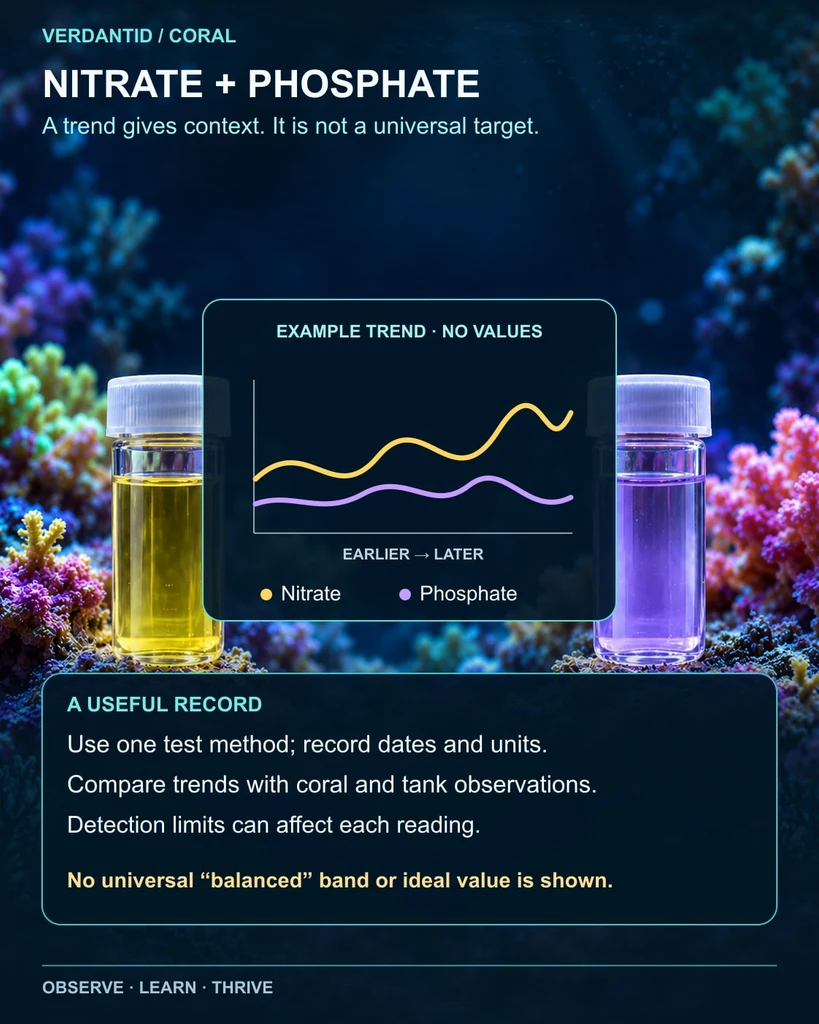
Record nitrate and phosphate with dates and units, keep tests consistent, and compare trends alongside your coral observations. If adjusting export or feeding, take a measured approach and re-test.
**Avoid:** Trying to reach a one-size-fits-all ideal number, abruptly stripping nutrients from the system, or adding products without knowing the source of the reading.
**Discussion:** Have you ever changed your nutrient approach after looking at trends instead of a single result?
Sources and further reading
Community education offers possible explanations and observation steps; it does not confirm a diagnosis.
Source: Original Verdant guide