Corals Are Animals: Meet the Polyp
A coral may stay in one place and look like an underwater flower, but its living tissue belongs to an animal. Learning to recognize the polyp changes how you look at both growth and stress.
One animal, repeated
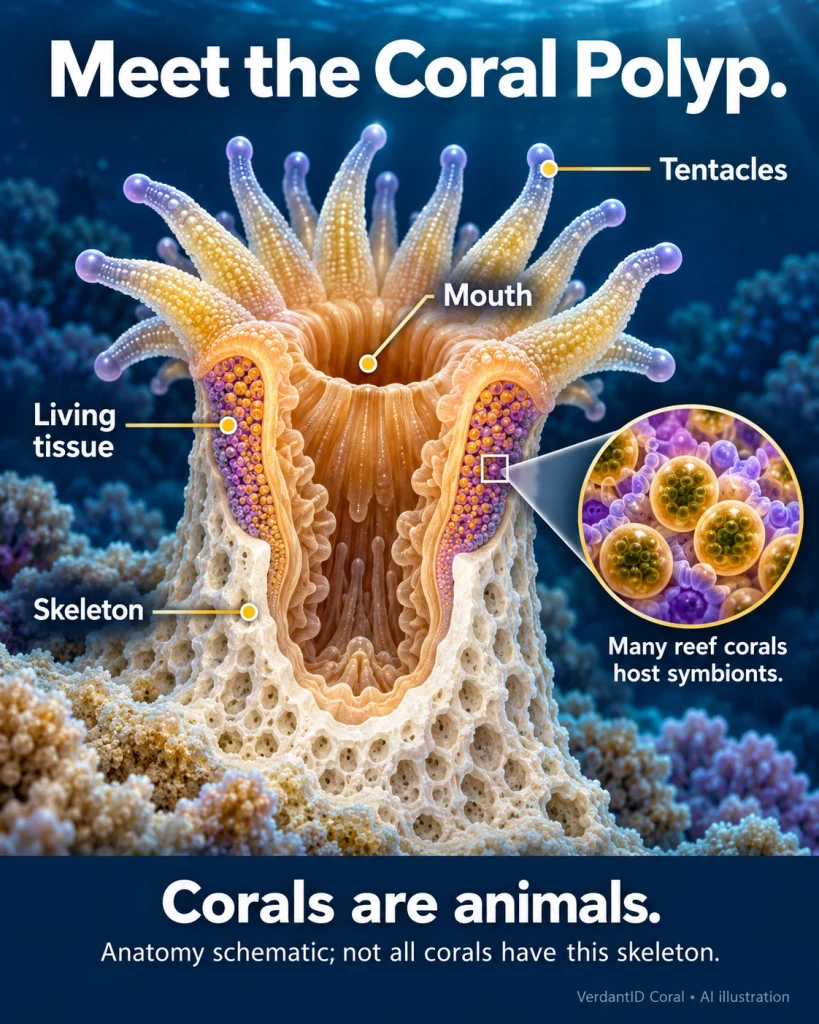
A polyp has a mouth surrounded by tentacles. Many corals form colonies of connected polyps; some are solitary. In stony corals, the living tissue lies over a calcium-carbonate skeleton. The skeleton is support, not the whole animal.
An important partnership
Many shallow-water reef corals contain photosynthetic symbionts in their tissues. The partners exchange resources, while the coral can also capture food. This is not a rule for every coral: deep-water and non-photosynthetic species have different biology.
Use anatomy when observing
- Look for tissue coverage as well as color.
- Compare polyp extension under similar conditions.
- Record changes without poking or scraping tissue.
A useful distinction
A pale-looking colony can still have tissue, and visible white skeleton can have more than one explanation. Anatomy helps describe what you see; it does not identify the cause by itself.
Join the discussion
What surprised you about coral biology?
Sources and further reading
Source: Original Verdant guide