A Dip Is One Step, Not a Complete Biosecurity Plan
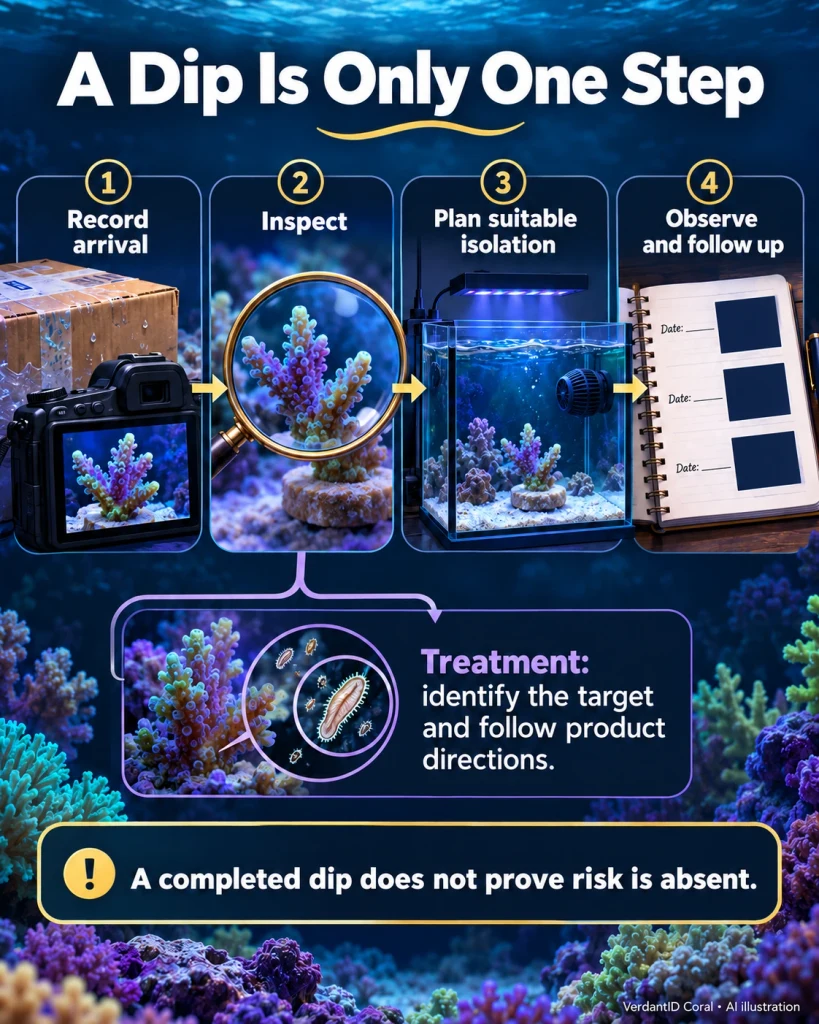
A product labelled as a coral dip does not make every organism, life stage or disease risk disappear. Think of arrival care as a sequence of decisions supported by identification and observation.
Start with a record
Keep supplier information, best-supported identity, arrival date and photographs. Inspect accessible surfaces without damaging tissue or handling potentially toxic colonies unnecessarily. Unknown findings are a reason to seek identification, not automatically to combine treatments.
Match the procedure to the product
Directions, coral suitability, target organisms and exposure conditions differ. Do not transfer a recipe from a different chemical or assume that a longer exposure is safer. Follow the actual manufacturer's instructions; this article deliberately provides no concentration or timed treatment protocol.
Observation remains useful
A suitable separate observation or quarantine arrangement should support the animal's needs and reduce cross-contamination. Plan equipment, water handling and follow-up checks before arrival. A rushed, unsuitable holding container is not a substitute for a considered system.
Keep the uncertainty explicit
An apparently clean photograph or a completed dip does not prove that all risk is absent. Ask for experienced guidance appropriate to the coral and suspected organism, especially if tissue is declining or chemical exposure is being considered.
Join the discussion
What's on your arrival checklist?
Sources and further reading
Source: Original Verdant guide